
Korea food is very regional and every region has its own special food. Here's a list of the different Korean local foods I recommend trying in the different parts of Korea.

Tip: if you're visiting a region I've not included in this list, you can find it's specialty by searching for the name of the region & 대표음식 (The results are often in Korean so you will need to translate them.)
Busan: Dwaeji Gukbap 돼지국밥 (Pork Rice Soup)
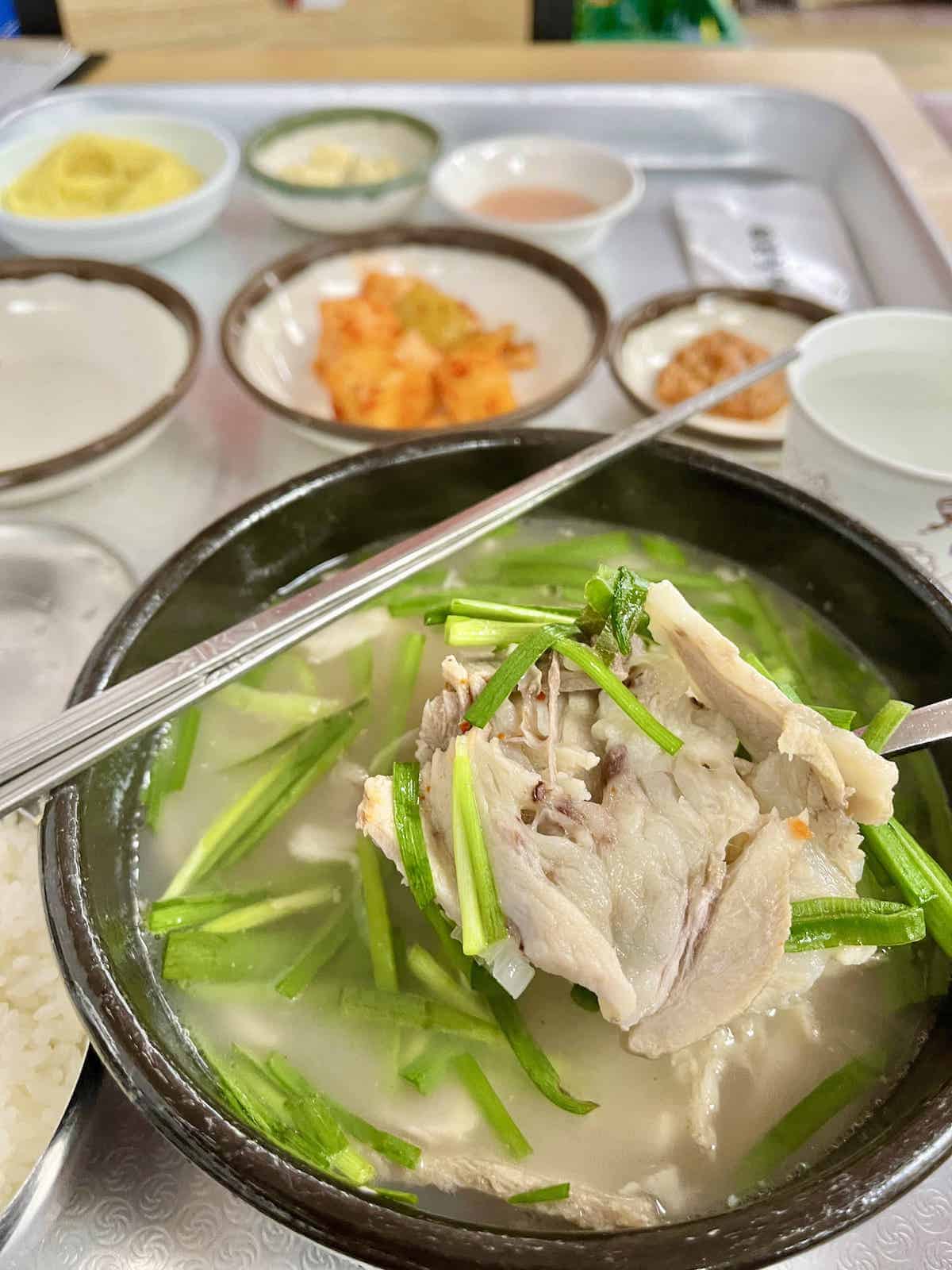
This is 1 of my favorite Korean dishes- I had this comfort dish so many times in Busan! Gukbap is said to have been invented in Busan due to rationing shortages: they found that boiling pork bones produced a delicious dish!
If you've watched "Marry My Husband", you'll know that you're meant to add the side dishes (salted shrimp, chive salad etc) to the rich pork broth (which has tender slices of pork and comes with a bowl of rice.)
Where to Eat: Seomyeon Market is famous for its row of Gukbap Restaurants and you'll often see a line of people queueing up for it there.
I've tried it in other parts of Busan and like the ones I had at Seomyeon Market best- just be warned, Busan isn't a posh city and Seomyeon Market is proof of that. Having said that, the Gukbap in Myeongdong was pretty good too.
Seoul: Seolleongtang, Kal-guksu & Binttaetteok

Kal-guksu (Knife cut noodles) and binttaetteok were featured in Netflix's Street Food documentary.
Seolleongtang, ox bone soup, is said to have been invented in Seoul (but it's hard to find a good one these days. Like Gukbap, the soup needs to be boiled for a long time to be flavourful.)
Where to Eat: If you want to be true to the show, then you need to visit Gwangjang Market!
Chuncheon: Dakgalbi 닭갈비
I had this spicy, stir-fried chicken dish on my 2nd trip to Korea and LOVED it so much, I've had it on every one of my (about) 8 trips since then.)
Invented in 1960, the chicken is cooked in a red sauce in a massive cast-iron pan right at your table. At the end, you can stir-fry the remainders with rice (ask for "bokkeumbap") or noodles- my favorite part of the dish! (You can also ask to add cheese.)
Many people like to order Makguksu, a chilled buckwheat noodle usually served with sugar, mustard, sesame oil or vinegar, to finish off their dak-galbi.
Where to Eat: Chuncheon has 3 dakgalbi streets, the most famous is Chuncheon Myeongdong Dakgalbi Street (춘천 명동 닭갈비 골목). Alternatively, Yoogane is a popular Dakgalbi chain that you can find all over Korea.
Jeonju: Bibimbap 비빔빕
Jeonju is famous for both its beautiful hanok village (traditional Korean houses) and its food culture- it's the food capital of Korea, best known for being the birth place of bibimbap (rice topped with assorted vegetables.)
The rice is different from what you get elsewhere- often cooked in beef brisket broth.
Jeonju is an easy trip from Seoul, under 2 hours, so there's no reason to miss it!
Jeju Island: Heuk-dwaeji 흑돼지 (Black Pork) & Haenyeo caught seafood
Jeju is THE place to eat in Korea: all the best dishes I've had in Korea were on Jeju!
Jeju’s famous black pigs are known for their tender flavourful meat, which is often grilled over charcoal then dipped in meljeot (a salty, fermented anchovy sauce) that prevents the rich pork from being too much.
Tip: Try Jeju samgyeopsal! (In case you were wondering, only the kin and not the meat is black.)
However, I personally prefer eating Haenyeo-caught Seafood in Jeju, such as the Abalone Porridge above.
Just note Korean Abalone Porridge isn't a dish for the fainthearted- it uses the guts/ intestines of the abalones which gives the dish a very deep flavor, which is not to everyone's taste. In Seoul, the abalone porridge often leaves out the guts, making the dish much more wildly palatable, but also less unique!
Daegu: Fried Chicken & Apples
Daegu is the capital of Korean Fried Chicken, and Daegu women are known for being pretty- something often attributed to their eating a lot of their famous apples!
I'll be honest- I first visited Daegu in 2010 and said I would never go back. However, the city is much more interesting these days!
Where to Eat: “Pyeonghwa Market Dakttongjip Street” (Ayang-ro 9-gil, Dong-gu, Daegu, and the surrounding areas) at Pyeonghwa Market. Kyochon Chicken, Ttang Ttang Chicken, Jong Kuk 2 Chicken, and Hosigi Double Chicken spread from Daegu to the rest of Korea.
When to Visit: I prefer not to visit Korea in summer but, if I did, I would visit Daegu Chimac Festival (a fried chicken festival held around Duryu Park in the summer.)
Geumsam: Ginseng (Insam)
Geumsan is the birthplace of ginseng (insam) in Korea. A good way to try Ginseng is in samgyetang, ginseng chicken soup, which is a popular "health food" in Korea during the summer.
Tip: visit during the annual Geumsan Insam Festival!
Suwon: Wang Galbi (Large & Tasty short ribs)
Suwon was a major cattle market, hence why they are so good at cooking beef ribs.
"Suwon Wang-galbi" (Suwon king ribs) are massive ribs cooke marinated in a light, salt-based sauce (different from the soy sauce version you get elsewhere.)
Andong: Jjimdak 찜닭 (Braised Chicken)
Andong is known for its jjimdak, a braised chicken dish with vegetables, chewy glass noodle, and a savory, sweet, and slightly spicy soy-based sauce.
Tip: Bring your appetite and wash it down with some Andong soju! Walk off you meal with a trip to Andong Soju Museum: Traditional Food Museum (where you can try soju samples.)
Sokcho: Dakgangjeong (Sweet & spicy fried chicken) & Seafood Sundae
Korean Fried Chicken can be found everywhere from LA to Seoul, but Sokcho is famous for its version, dakgangjeong.
Double-fried (i.e. extra crunchy) and coated in a sticky, sweet glaze, it's often eaten cold/ at room temperature.
Tip: Learn from the locals and have it chimaek style (with some beer.)
Pohang: Mulhoe (cold raw fish soup)
This thinly sliced raw fish is served in an icy and spicy broth with a hint of tang- perfect for hot Korean summers!
However, I have to be honest and say Korean raw fish is 1 of the few dishes I would not recommend eating in Busan.
Tongyeong: Chungmu Gimbap 충무김밥 (Rice Rolls)
Unlike the typical Korean gimbap, Chungmu Gimbap are small plain rice rolls- just wrapped in seaweed.
What you might have gotten inside the gimbap is instead served on the side: spicy marinated squid and crunchy radish kimchi. It was invented as a meal for fishermen because the ingredients didn't go bad as fast.
Fun fact: Chungmu is the old name of Tongyeong.
Gyeongju: Hwangnam-ppang (Bread)
Dating back to 1939, this small, thin-crusted pastry is filled with sweet red bean paste.
Uijeongbu: Budae-jjigae 부대찌개 (Army stew)

Invented after the Korean War due to shortages, this stew is a fusion dish that combined extra US military rations such as Spam, and baked beans, with traditional Korean foods (kimchi and gochujang.)
Be warned: even a portion for 1 is HUGE! You're often given noodles to add to the soup or rice.
Where to eat: Uijeongbu Budaejjigae Street is a (slightly hard to find) alleyway outside Jungang Station where there are about 10 specialty restaurants serving budaejjigae.
Incheon: Jjajangmyeon 자장면 (Black Bean Noodles)

Incheon is Korea's largest Chinatown- Jjajangmyeon was invented at at the restaurant Gonghwachun in Incheon by a Chinese immigrant in 1905.
It sounds like the traditional Chinese dish- Zha Jiang Mian- but the 2 don't taste alike!
Gangneung: Chodang Sundubu (Soft tofu)
Gangneung tofu has a naturally light, nutty and salty taste, due to using seawater from the East Sea as the coagulant.
Tip: If you're not a fan of milder flavours, this may not be for you. The tofu usually comes in a clear broth (to allow the quality of the tofu to shine through.)
Where to Eat: Chodang Dubu Village where you'll find over 20 restaurants serving tofu dishes.
Suncheon: Dwaeji Mori-gukbap (Pig Head Soup)
At the famous Gukbap Alley in Utjang Market, you usually get steamed pork slices (suyuk) and sausage (sundae) for free if you order 2 bowls of soup.
The soup is made with meat from the pig’s head (said to be richer than the typical cut) and bean sprouts.
Other Korean Local Food Specialties to try
- Gochang: Eel
- Tongyeong: Oysters
- Naju: Gomtang (Beef Soup)
- Boseong: Green Tea
Any questions about Korean regional food specialities? Let me know in the comments!

Leave a Reply